Filter Bags
Filter bags are widely used across industries including chemical processing, food and beverage production, pharmaceuticals, water treatment, coatings, inks, and general manufacturing. Available in a variety of media types and filtration ratings, they can be tailored to meet specific process requirements, including particle retention, operating temperature, chemical compatibility, and flow rate.
Whether used for pre-filtration, process filtration, or final filtration, filter bags provide reliable performance and are available in configurations ranging from economical disposable bags to specialist solutions such as absolute-rated, extended-life, oil-absorbing, and water-absorbing filter bags.
Their flexibility, ease of installation, and low operating costs make filter bags one of the most widely used filtration technologies in modern industrial processes.
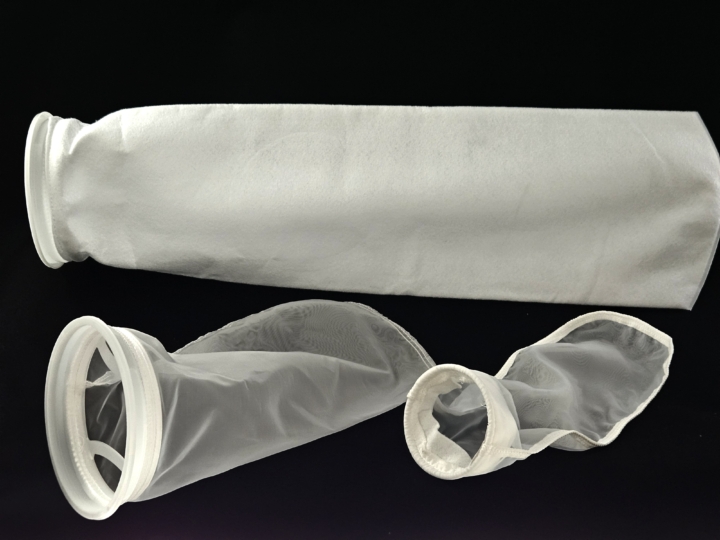
How do filter bags work?
The operation of a filter bag is based on separating solid contaminants from a liquid stream:
Incoming liquid – filtration/separation – filtered liquid
As contamination accumulates within the filter bag, the differential pressure (ΔP) across the filter media will increase. Once the maximum recommended differential pressure is reached, the filter bag should be cleaned (where applicable) or replaced to maintain optimum filtration performance.
For most filter bag applications, a maximum differential pressure of 2.0 to 2.5 bar is recommended.
Quality and Compliance
Our filter bags are widely used in food and beverage applications where product safety, quality, and regulatory compliance are essential. To meet the requirements of these industries, we offer filter bags manufactured from materials that comply with recognised food-contact regulations, including FDA and EC 1935/2004.
Our filtration specialists can advise on the most suitable filter for your specific process.
Filter bag specifications
Filter bags are available in a wide range of configurations to suit different process requirements and operating conditions. Selecting the correct filter bag is essential to achieving optimum filtration performance, service life, and process reliability.
When specifying a filter bag, the following parameters should be considered:
Filter bags are available in two primary media types: Needle-felt and mesh. Each media type is available in a range of materials, including polypropylene, polyester, nylon, PTFE, and other specialist polymers.
The key difference between these media types lies in the filtration mechanism. Needle felt filter bags operate according to depth filtration, where contaminants are retained throughout the thickness of the filter media. Mesh filter bags operate according to surface filtration, where particles are retained on the surface of the mesh.
Each filter media offers unique characteristics that must be matched to the process conditions and filtration objectives. Factors such as operating temperature, chemical compatibility, contaminant type, particle size distribution, and required filtration efficiency all influence the selection of the most suitable filter bag material.
The Filtration efficiency, also known as micron rating, varies depending on the media choice. The range is typically between 0.5 – 2000 microns, with Needle-felt falling in the 0.5 – 200 micron range and Mesh falling in the 1 – 2000 micron range.
There are many lengths and diameters available, including custom-made filter bags, but the standard options have the following lengths and diameters:
- Length 1: 430mm x Ø180mm (surface area approx. 0.25m²)
- Length 2: 810mm x Ø180mm (surface area approx. 0.50m²)
- Length 3: 230mm x Ø105mm (surface area approx. 0.07m²)
- Length 4: 380mm x Ø105mm (surface area approx. 0.12m²)
- Length 5: 528mm x Ø152mm (surface area approx. 0.20m²) (for X100 filter housing)
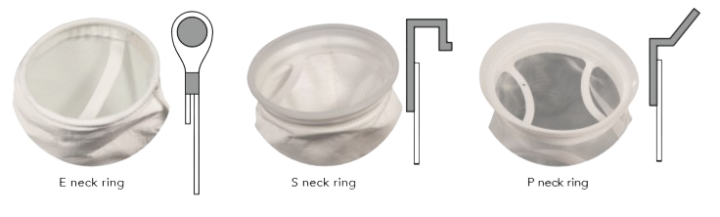
In addition to the filter media, the choice of filter bag ring is an important consideration. The ring provides the mechanical support and sealing interface between the filter bag and the filter housing, helping to prevent bypass and ensure reliable filtration performance.
As with the filter media itself, ring selection is influenced by process conditions such as operating temperature, chemical compatibility, and any food-contact requirements. Common ring materials include carbon steel, stainless steel, polypropylene (PP), and polyester (PE).
The design of the filter housing must be considered, as not all ring types are compatible with every housing configuration. Different ring designs and dimensions are available to suit a wide range of bag filter housings and process requirements.
Our filtration specialists can advise on the most suitable ring material and configuration to ensure optimum compatibility, sealing performance, and service life.
Applications of filter bags
The filter bags can be used in a variety of applications, including:
- Polymers
- Beverages including soft drinks and beer
- Edible oils
- Paint
- Pigments
- Coatings
- Water treatment
- Resins
- Automotive and sugar industry
- Fuel
- Gelatin
- Polymers
- Glue
- Inks
- Lubricating oil
- Pigments
- Cheese
- Colorings and flavorings
Selecting the right filter bag
Selecting the correct filter bag requires consideration of both the process fluid and the type of contaminant being removed. The filter media must provide adequate chemical resistance and be capable of operating at the required process temperature.
The nature of the contaminant is equally important. Factors such as particle size, concentration, hardness, shape, and characteristics such as gel-like or thixotropic behaviour can significantly influence filter bag performance and service life.
For many applications, polypropylene and polyester filter bags provide an effective and economical solution. However, more demanding applications may require specialist materials such as Nomex® or PTFE, where higher temperature resistance or enhanced chemical compatibility is required.
The choice of sealing ring is also important, as it ensures an effective seal between the filter bag and the support basket within the filter housing. Ring options are available in a variety of materials and designs to suit different housing designs.
While filter bags are most commonly installed in dedicated bag filter housings, alternative mounting methods are also available. In some applications, filter bags can be supplied with a drawstring closure for installation directly onto pipework or other process equipment.
Our filtration specialists can help identify the most suitable filter bag configuration based on your process conditions, contaminant characteristics, and filtration objectives.
Range Techno Filter
Techno Filter offers a comprehensive range of filter bags to suit a wide variety of industrial filtration applications. The foundation of our product portfolio consists of mesh filter bags and needle felt filter bags, complemented by a range of specialist solutions including extended-life, absolute-rated, water-absorbing, and oil-absorbing filter bags.
With a wide selection of filtration media, micron ratings, dimensions, and sealing configurations available, we can provide a filter bag solution tailored to virtually any process requirement.
In addition to filter bags, Techno Filter also supplies a complete range of bag filter housings manufactured from materials including stainless steel 304, stainless steel 316L, PTFE-lined steel, Hastelloy, plastic, and Super Duplex stainless steel. Bag filter housings are available in both single-bag and multi-bag configurations and are suitable for standard filter bag sizes 1, 2, 3, and 4.
For more information about our housing range, please visit our Bag filter housings page or contact one of our filtration specialists for technical advice.
Contact our team
Techno Filter is available by telephone on business days (Monday to Friday) from 08:30 to 17:00 at +31 (0)297 524 131, or by e-mail at info@technofilter.nl